
Early History
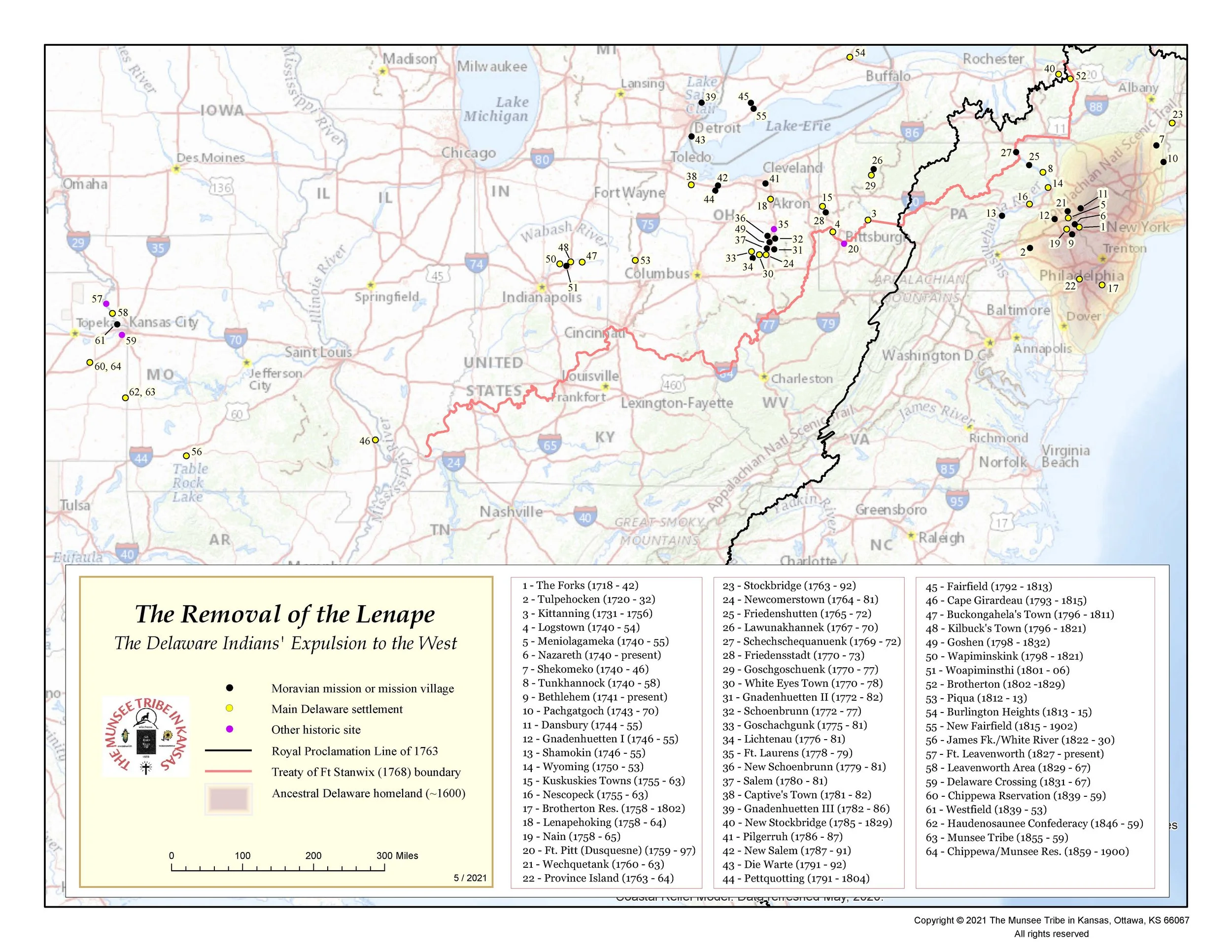
The history of The Munsee Tribe in Kansas starts with the Lenape Tribe,
long before the United States would be established. The Lenape Tribe homelands make up the regions of present-day Pennsylvania, New York, New Jersey, and Delaware.
[Map: “The Removal of the Lenape",” created by Karl Johansen for The Munsee Tribe in Kansas in 2021. The yellow dots represent Munsee settlements over time as they were pushed further west by white settlers.]
The Lenape were semi-nomadic people who relied on rivers and the coastline for their lifestyle. While they did practice some early farming, they primarily fished, hunted waterfowl and river mammals, and harvested mollusks for food. They built their homes, canoes, and tools from reeds and other plants that grew along the coast and used shells to create wampum. Wampum was made by smoothing pieces of purple and white whelk shells into small, hollow beads, and stringing it together. Wampum was used as both a currency, because of how labor intensive it was, and as a form of communication. [i]
The Lenape were made up of three primary clans: Wolf, Turtle, and Turkey. In early history, intermarriage between the clans was common, and a distinction would not be made as prominently until after the first contact between the Tribes and Europeans. The Munsee Tribe in Kansas descends from the Wolf Clan, as represented by the wolf on the Tribal Seal.
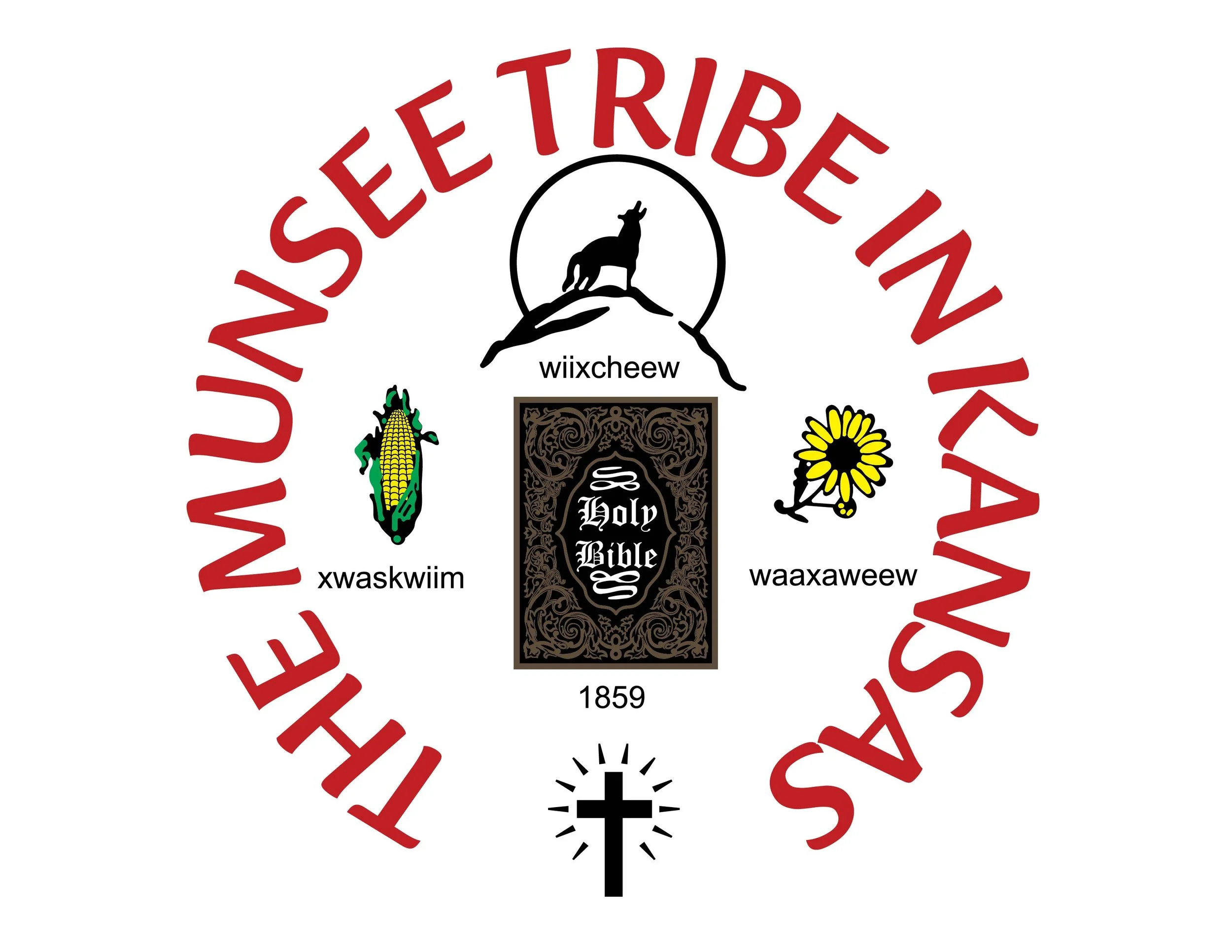
The Munsee Tribe in Kansas Tribal Seal. The Holy Bible in the middle represents the Bible used by the Tribe on the Reservation, which is now privately housed at the Franklin County Historical Society. The wolf represents the Wolf Clan of the Lenape, from which the Munsee descend. The Sunflower represents the state of Kansas. The cross represents the Moravian Church and their influential role in The Munsee Tribe in Kansas. The corn represents the sustainability and heritage of the Tribe and the crop that, historically, was grown most often on their farms.

The wampum belt allegedly presented to William Penn at the “Great Treaty” by the Lenape Tribe. It is currently held in the archive of the National Museum of the American Indian in Washington D.C.
Early contact between the Tribes and Europe was conducted through fur traders and explorers on the Northeast coast of the Atlantic Ocean. As European colonists began to arrive and claim Indigenous land, the Lenape were pushed further east. One of the first treaties established between the Lenape and the Europeans was with William Penn, who is most well-known for founding the state of Pennsylvania. He first made contact with the Lenape Tribe in the early 1680s and would later go on to establish the “Great Treaty” with the Tribe in 1682. Reportedly, the Lenape presented William Penn with an elaborate wampum belt at this meeting, which is now housed at the National Museum of the American Indian. [ii] Photo and information courtesy of the Smithsonian Institute and the National Museum of the American Indian
Unfortunately, the peaceful coexistence that the Great Treaty sought to protect did not last. In 1737, William Penn’s sons approached the Lenape with the claim that a deed had been signed in 1686. According to them, this deed granted Penn as much land from the Lenape that he could walk in a day. Not only was this claim false, but the Penns hired three fast runners to establish the borders of the land for them. The “Walking Purchase,” therefore, resulted in an acquired 55 miles, totaling to 1200 miles taken from the Lenape to become Pennsylvania. [iii]
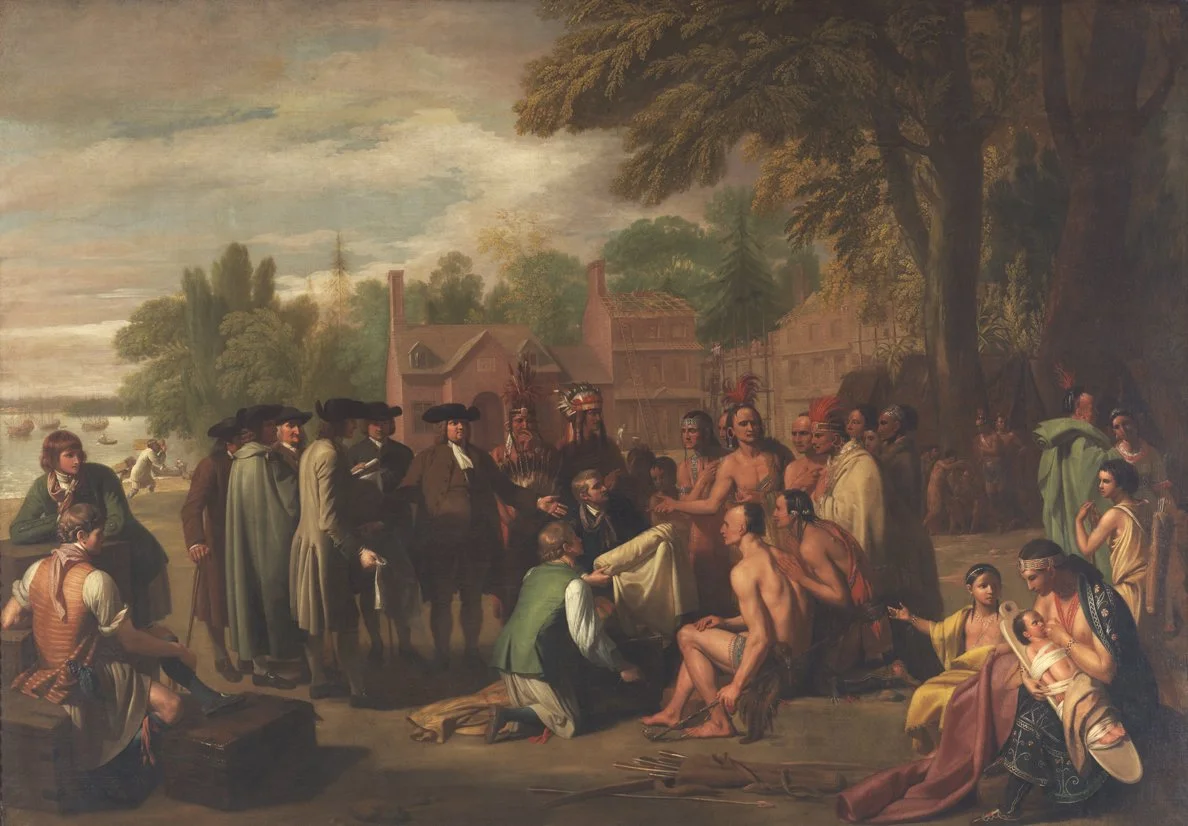
[Painting: Penn's Treaty with the Indians by Benjamin West, c. 1771 - 1772. Courtesy of the Pennsylvania Academy of the Fine Arts.]
Sources:
[i] 1913 M. R. Harrington (A Preliminary Sketch of Lenape Culture, American Anthropologist, Vol. 15, No. 2, p. 217).
[ii] Speck, Frank Gouldsmith. The Penn wampum belts. [The De Vinne press], 1925. doi: https://doi.org/10.5479/sil.91061.39088011514007
[iii] PDF Page 15: Soderlund 2015 (Lenape Country) - "early contact..."